Skip to content
HumberleaLock ExpertsOpen 24/7 (289) 804-5807
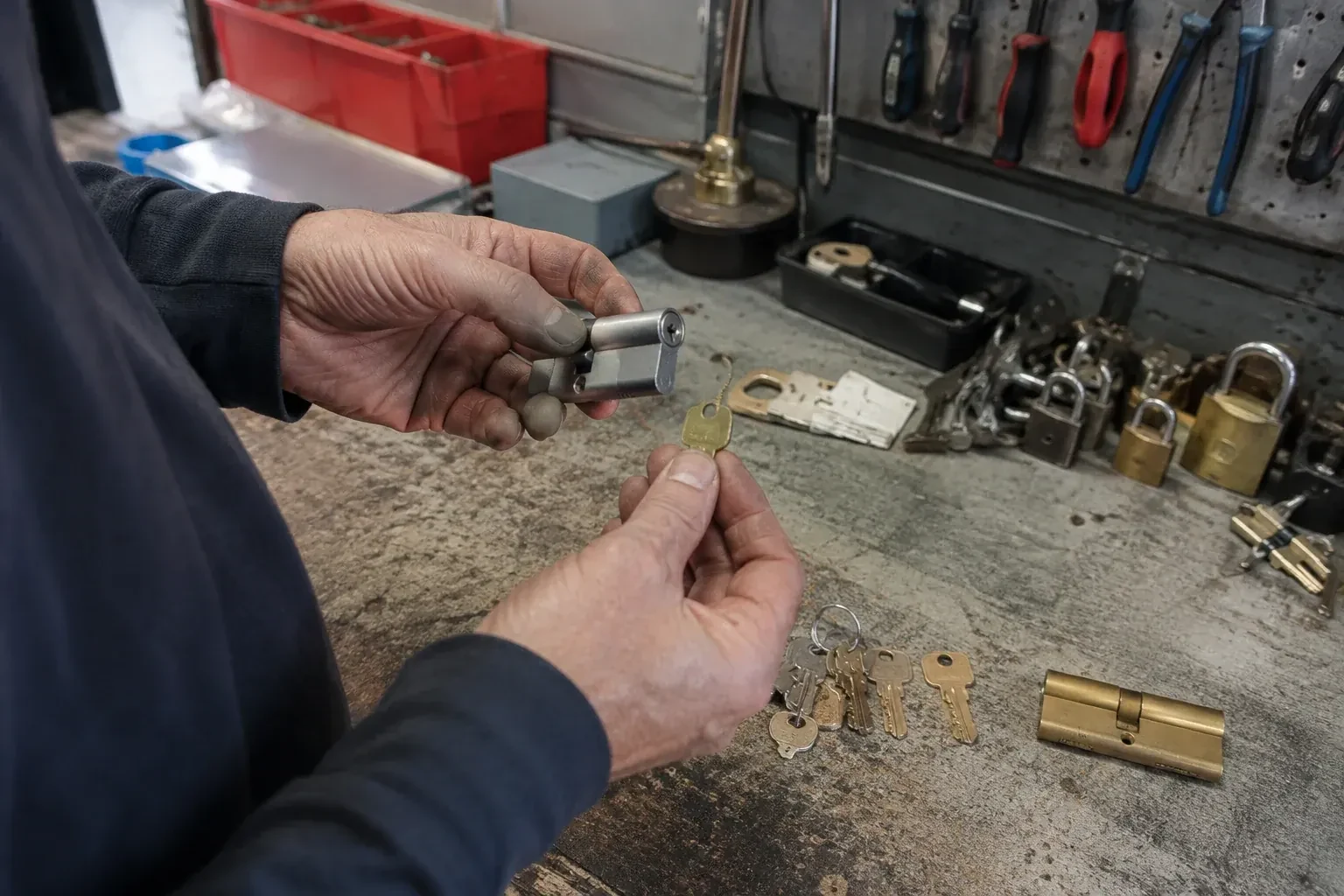
Hands holding a silver-colored lock cylinder and a brass-colored key above a workbench with padlocks, keys and tools. — Master Key System Design, Weston

Commercial · Weston

Master Key System Design

A self-storage operator wants the office, the tenant gate and the equipment shed on three different levels of access for staff, but every lock on the property currently answers to the same handful of interchangeable keys handed out over the years.

In plain words

The process behind a master key system runs from conversation to chart. First comes a walk-through of every door and a conversation about who needs to open what, now and as the business grows. Next comes the design itself: grouping doors into change-key sets, deciding where sub-masters belong, and reserving a top-level master for a short list of people. Then the cylinders are pinned, cut and tested individually before any key is handed over. What the owner receives at the end is not just keys but a working hierarchy matched to compatible hardware and documented in a chart they control.

Sound familiar?Weston

The call
A new hire at the shop gets handed whatever spare key happens to be in the drawer, and it turns out to open the stockroom, the back office and the safe room all at once. The owner realizes nobody actually decided who should open what.

NextHow the visit goes

Master Key System Design · Weston

How the visit goes

Person leaning over a blue bench machine in a small shop with keys, padlocks and door hardware displayed on blue walls. — Weston
  1. Scene 1

    Who needs to open what

    Before any hardware is chosen, the locksmith records the organization's actual shape: which roles, departments or shifts need access to which doors, including exceptions such as a bookkeeper who needs the records room but not the loading dock. This map is built with the owner or manager, not guessed from existing keys, since existing keys often reflect years of ad hoc copying rather than any real plan. The output is a plain list of who should open what, which becomes the target the rest of the design is measured against, well before a single cylinder is touched or a key is cut.

  2. Scene 2

    Marking and cutting the actual keys

    Keys are cut to the bittings set out in the key schedule and marked in a way that identifies the holder's role or level rather than the door or address it opens, so a key found on its own gives away as little as possible about the building it belongs to. Quantities match what was agreed during the assessment, with each one logged by serial against the person or role receiving it. Blanks for a restricted keyway are cut only against the owner's authorization, keeping future duplication inside the same controlled record.

  3. Scene 3

    A chart that answers the question on its own

    Once the project is finished, a single question, who can get into this room, has a single answer, visible on the chart without needing to track down whoever issued a key years ago. Every level is listed against the doors it opens and the people or roles holding it, so the record stays useful long after the locksmith has left, rather than fading into the same guesswork the project was meant to replace.

In the van

  • Compatible replacement cylinders
  • Keying chart
  • Cylinder decoders
  • Plug follower and key gauge
  • Cylinder pinning kit

What shapes the quoteHumberlea Lock Experts

Working around an occupied, operating property
Rekeying doors in a planned sequence so a business keeps operating throughout, rather than all at once, takes coordination with the owner's schedule. Properties that need this staged approach, with interim arrangements for doors mid-conversion, add planning time beyond a straightforward, all-at-once installation.
Any optional upgrade chosen along the way
Some businesses use the project as an opportunity to also upgrade a door closer, add a keypad to one entry, or reinforce a strike plate. None of this is required for the master key system itself, and each optional item is quoted as its own line.
Collecting and retiring old keys
Gathering up old keys that are being replaced, confirming they no longer operate any cylinder, and retiring them from circulation is a small additional step some businesses want included, separate from the core design and cutting work.

FeesSame any hour

Have it ready

Before you call · 0 / 3

(289) 804-5807

Things people wonder about

What does key control actually mean?

It means knowing, at any time, how many keys exist for a given door or level, who holds each one, and how a new copy would be authorized. A master key system supports key control by design, since keys are marked by role, logged by serial, and cut only against the chart, rather than copied informally whenever someone asks for one.

Can different lock brands be mixed in one master key system?

Sometimes, but it depends on the keyway and pinning platform each brand uses; some are compatible with one another and some are not. Where a mix already exists on a property, the assessment identifies which cylinders can be brought into a single hierarchy and which need replacing with a matching platform so every level pins correctly across the whole set of doors.

Can key duplication be restricted so copies cannot be cut elsewhere?

Yes. With a restricted or patented keyway, blanks are only available through the manufacturer's authorized record, so a copy is not cut at an ordinary hardware counter without going through that channel. This does not make a key impossible to duplicate, but every legitimate copy passes through a record the owner controls, which a standard keyway cannot offer.

Westoninformation

TorontoOntario

Town
Weston, Toronto
In business
13 years
Hours
Open 24/7
Nights, weekends and holidays, same fees
Visits
On-site assessment preferred. Request a visit or call.

2021 census: what it means at the door

Every square is one home in a hundred.

  • 58 in 100 homes · older homes
  • About 58% of homes in Toronto were built in 1980 or earlier, according to the 2021 Census.Basement and side entries on older homes were often fitted long after the house was built, with whatever lock was on hand. Bringing those doors up to the standard of the front entry, and onto the same key, is a common and satisfying job.
  • Single-detached houses make up about 23% of homes in Toronto (2021 Census).Landlords and property managers dominate in attached housing, and they want keys organised. A locksmith sets up master systems so a manager carries one key while each tenant's key opens only their own door.

Source: Statistics Canada, Census Profile

Open Weston in Google Maps

On-site assessment

Request a visit.

A self-storage operator wants the office, the tenant gate and the equipment shed on three different levels of access for staff, but every lock on the property currently answers to the same handful of…

(289) 804-5807, open 24/7.